Herek's Blog
The Art & Science of
Client Retention
The place where I share my deep thoughts, observations, experiences, and frameworks
#30: Why Most Client Retention Tactics Don't Work
(And What Actually Does)
You've installed the CRM system for your business.
You thought the dashboard could provide data to keep track of customers and clients.
You thought removing the person who didn't read your emails for the past 3 months was a great idea.
You thought sending automated birthday greetings to clients would make them feel valued.
You followed the email marketer's advice.
You emailed your list daily to communicate with them and sell them stuff.
Every email contained an offer they could buy.
You thought you were building "top of mind awareness"...
So they remember you when they need your products or services.
You run loyalty programs.
You give discounts to long-time customers and clients.
You thought they'd be happy with the perks.
You thought retention should be done this way.
But you realize...
Your retention rates aren't improving.
People unsubscribed from your list.
Email open rates aren't higher.
Many people don't even open your emails anymore.
Clients and customers who bought in the past stopped buying now.
What's going on?
Why did retention fail despite following retention advice to a T?
It's NOT your fault.
Because you've been misled.
I'll show you what you've been missing all these while.
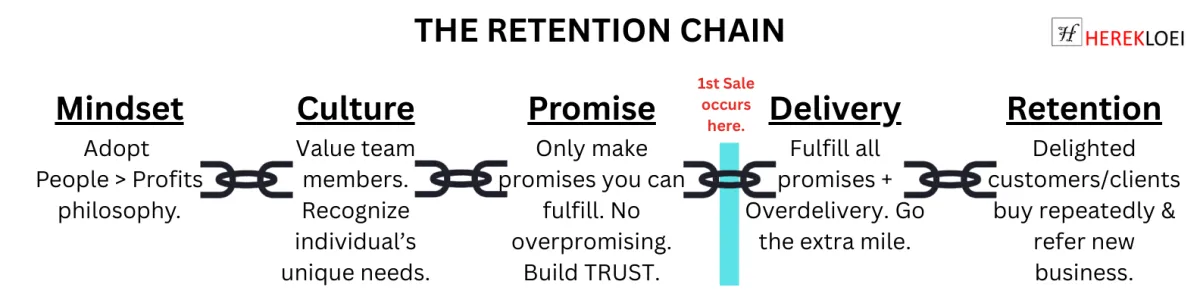
This is why Most Retention Tactics Fail
Look at The Retention Chain above.
Did you realize that Retention is an outcome?
For an outcome to occur... You don't focus on the outcome itself.
You focus on the steps that lead to the outcome.
This is what I learned in my sports psychology class: Outcome goals vs process goals.
For example...
My outcome goal is to lose weight.
My process goal is to exercise a certain frequency a week.
And to have a daily calorie intake of X kcal.
I will not lose weight just by weighing myself on a scale daily.
Similarly... If an athlete wants to win a gold medal.
They do not keep thinking "I want to win".
Because winning is an outcome.
It doesn't happen just because the athlete focuses on it.
The athlete has to focus on the right training, the right nutrition, and getting sufficient rest.
By the time all these critical aspects are optimized...
The chances of getting the gold medal are maximized.
Now, let's look at what many businesses are doing for retention.
They use retention tactics like CRM, email follow-up sequences, loyalty programs, and discounts.
With reference to The Retention Chain....
Those businesses are trying to fix retention by focusing on the Retention level.
But as with anything else, retention doesn't work that way.
Retention has to be fixed by focusing on the processes prior.
By the time most retention tactics are deployed...
Trust has often been eroded significantly.
Multiple trust leaks have already occurred repeatedly in the client journey.
Tactics can't fix what a broken philosophy created.
Even if people decide to come back and take up the promotions or discounts...
That's purely due to Utility Retention.
There's no loyalty.
Once a better alternative appears, people leave again.
That's not what we want.
We are aiming for Voluntary Retention.
Since retention is the outcome in The Retention Chain.
It means we should look at everything that occurs before Retention.
Namely:
1) Mindset.
2) Culture.
3) Promise.
And
4) Delivery.
Those 4 steps lead to voluntary retention.
People stay willingly.
Because they're happy.
They trust the business.
And they see meaning in staying with the business.
This is the Retention Formula.
The Retention Formula highlights the elements needed for Retention to happen.
The Retention Chain illustrates what businesses need to do at a systems level...
So that Retention occurs naturally.
Retention drives the whole business.
It happens before the sale. Not after.
It starts at the first point of contact with a prospect.
First impressions count.
Retention is designed intentionally.
It's not an afterthought.
Now, I'll deep dive into each step leading up to Retention.
We start with the first step: Mindset.
Fix the Mindset, Fix Retention
When your mindset is misaligned with the outcome you want...
It's very difficult to attain the desired outcome.
Words and actions will be incongruent.
Even if a person pretends and performs...
The real self tends to surface eventually.
It's only a matter of time for the mask to slip.
This applies to retention too.
The key principle is:
People like to be served, not sold.
Service > Extraction.
People > Profits.
When you serve people genuinely and prioritize their interests first...
They tend to trust you more.
Trust in Intention is gained.
People can feel your intentions even if they've trouble articulating it.
So for a business that prioritizes Profits > People...
They can pretend that they care for their clients.
But when inconsistency and incongruence show...
Trust in Intention is broken.
Broken trust is usually irreversible.
People don't easily trust a person who lied to them before.
They usually don't buy from the business anymore.
Why company culture makes or breaks retention?
If you're a solopreneur... Your own shift in mindset is sufficient.
There are no team members or employees for you to impart the People > Profits philosophy.
But if you have a team...
It's critical to pass the right mindset to your team.
So the company culture is aligned to always serve first... And always put people first.
Most businesses obsess over profits.
To the point that humans are seen as dollar signs and numbers.
They set revenue goals as KPI for their team members.
Team members feel like a tool... A resource to be extracted.
Naturally, they'll treat the clients and customers the same way.
They'll try to extract more money out from the clients to hit their own KPI.
It's the founder's responsibility to ensure the right company culture is set.
It's also critical to hire people who are aligned with the same values.
Hiring a team member with an extractive mindset can damage clients' trust.
Even if the founder preaches People > Profits...
Poor team communication will lead to a deviation from the core philosophy during client interaction.
There must be congruence between the messaging and the behaviors of the team members.
If the company proclaims that clients' interests are prioritized...
But the team members' actions don't reflect that...
The level of trustworthiness falls.
People may not believe in what the company says anymore.
Big Promises Gets The Sale But Can Backfire...
Big promises.
Big claims.
Hypey headlines.
These are commonly used by marketers and copywriters to grab attention.
The goal is to stop people in their tracks and consume the sales message.
If you think you can use that without long-term consequences...
Think again.
I've met many businesses who make big promises but couldn't deliver the outcomes.
That erodes Trust in Expertise and Trust in Competence.
They either don't have enough depth of knowledge to highlight the nuances...
Or they don't practice what they preach.
They can't explain why certain things work or don't work.
All they do is teach tactics without covering the underlying principles.
The big promises and claims set unrealistic expectations for the clients.
Clients are bound to be disappointed when fulfillment differs from the promises.
Disappointments are trust leaks.
They're seeds of retention failure.
Unhappy clients may leave poor reviews that tarnish the reputation of the business.
The poor reviews may be the reason why people don't buy in the future.
The long-term costs are:
It gets harder to convert new clients.
More marketing dollars have to be spent to acquire new clients.
Past clients don't make referrals due to the poor experience.
Trust and reputation compound when clients have a great experience with a business.
Using big promises and claims to get short-term sales may hurt businesses more than anyone thinks.
Why Delivery Phase Is Where Most Trust Leaks Happen?
The bigger the promises made... The higher the expectations clients will have.
That's how businesses erode trust when retention isn't intentionally designed before the sale.
Acquisition-focused businesses are obsessed with marketing, lead generation, and sales.
They focus on making the first sale.
But they neglect the second sale and beyond.
The delivery phase has the most trust leaks when unrealistic expectations have been set before the sale.
The business is unable to deliver the results they promised.
Some clients get disappointed and leave quietly.
Some clients get angry because they feel cheated.
These are the people who leave poor reviews and call them out as "Scams".
Another common scenario is when pre-sale warmth is met with post-sale coldness.
For example...
A mentor appears to care for people before people get into his coaching program.
People trust the mentor enough to invest big money and seek guidance.
Once money changes hands... The mentor changes attitude.
The clients' needs were dismissed condescendingly.
Clients feel the difference before and after the transaction.
Trust in Character erodes.
Because the behavior of the mentor is incongruent.
Erosion of Trust in Character can also lead to erosion of Trust in Intention.
When people doubt who you really are...
They doubt why you do what you do.
How All 4 Steps lead to Retention
By now, you should realize Retention isn't about tactics.
That's why the current commonly used retention tactics in the market don't work most of the time.
Retention is intentional.
It's systemic.
It's based on the core philosophy of People > Profits.
Once the philosophy is absent...
Everything downstream breaks.
Inconsistency and incongruence will surface.
Trust will erode.
Retention will fail.
Simply adopting the philosophy is also insufficient.
It needs to translate across the entire business.
So all team members are aligned with the company's core values...
And their behaviors will show during execution.
An aligned organization builds trust and sustains trust.
They become trustworthy.
People feel safe buying from such businesses.
Because they know their interests are prioritized.
They feel served, not extracted.
These loyal clients become advocates of the business and make new referrals.
This is the ultimate unfair advantage the business has in the market.
And it all starts from one philosophy.
People > Profits.
Always.
- Herek
P.S. If you'd like to explore more of my Client Retention content...
Feel free to follow me on the following platforms:
- LinkedIn.
- YouTube.
If you'd like to have a peek at my personal life...
I post more personal stuff on:
P.P.S. In case you missed it... Read the Client Retention Top 10 FAQs HERE. Then you'll understand our philosophy behind everything we do.
I look forward to sharing more with you in the next post.
If you enjoyed reading this post... Feel free to check out the other posts!
Table of Contents
#8: What Is The Retention Architecture Model: The 3 Layers Explained
#9: The Hidden Costs Of Ignoring Retention Principles (No One Talks About This)
#10: Why Clients Still Leave Despite Enjoying Great Service?
#11: Why Have Traditional Marketing Tactics Lost Effectiveness?
#13: Why Businesses Lose Clients: The Hidden Role Of Trust Leaks
#16: Where Does Client Trust Break Down? The Trust Leak Stages Explained
#17: Why Tactical Optimization Can't Fix Weak Business Foundations
#18: What Should Consultants Do When Clients Insist On Their Ideas?
#21: Why Do Clients Request A Refund? (It's Not What You Think)
#22: Case Study 1 - How Retention Principles Saved A Marriage...
#25: Read This If You Use AI In Business (It's Killing Client Retention... And More)
#29: How To Increase Client Lifetime Value Using Retention Principles
#30: Why Most Client Retention Tactics Don't Work (And What Actually Does)
#31: Why Business Partnerships Fail (And How Retention Principles Fix It)
#32: How To Increase Client Retention (Without Contracts & Loyalty Programs)
#33: Planned Obsolescence: How Software Updates Quietly Profit From Your Trust
#34: The Retention Architecture System: How All The Frameworks Come Together
Disclaimers: The content in this blog contains the personal opinions of Herek Loei. These are based on real-life events experienced by Herek, that shaped his worldview. Herek's sharing of experience does not mean you must agree with him. Herek does not impose his views on anyone. You're free to choose to stay on this site if what he shares resonates with you. If it doesn't, you've the choice to leave this site too.
Some events described in the blog may have happened many years ago. Herek can only narrate based on his memory. Herek can't cover the minute details. Hence, we make no guarantees that this page is 100% error-free.
We also make no representations that you'll make money from following the information provided on this page. Results will vary depending on how you implement what you learned. You agree NOT to hold us liable for your own decisions, actions, and lack of results.
Results variation depends on many factors, including but not limited to your background, knowledge, experience, and work ethic. All business entails risk as well as massive and consistent effort and action. If you're not willing to accept that, please do not consume our materials or attend our programs.
The information provided here is for educational purposes only. It does not represent any professional medical, legal, or financial advice. Consumer discretion is advised.
Copyright 2026. All Rights Reserved.
Revenue Growth Pte. Ltd. | Herek Loei