Herek's Blog
The Art & Science of
Client Retention
The place where I share my deep thoughts, observations, experiences, and frameworks
#34: the Retention Architecture System: How All The Frameworks Come Together
I've talked about many frameworks over the past 33 posts.
We've covered People > Profits, The Retention Formula, Retention Chain, Retention Architecture Model, FOCA, and the Trust Pie.
In this post, you'll gain clarity about how those frameworks come together...
And you'll understand each one's hierarchical positions.
The Core Philosophy
The core philosophy guiding all the retention frameworks to be effective is: People > Profits.
Without the right philosophy... Everything downstream breaks.
Because philosophy guides principle.
Principle guides strategy.
Strategy guides tactics.
Tactics determine the tools to be used.
The Overarching Principle
The embedded overarching principle within each framework is the Retention Formula: Trust + Meaning = Retention.
Trust is the foundation of every human relationship.
Trust is also the foundation for sales.
No trust = No sale = No retention.
The Macro View For Business Adoption
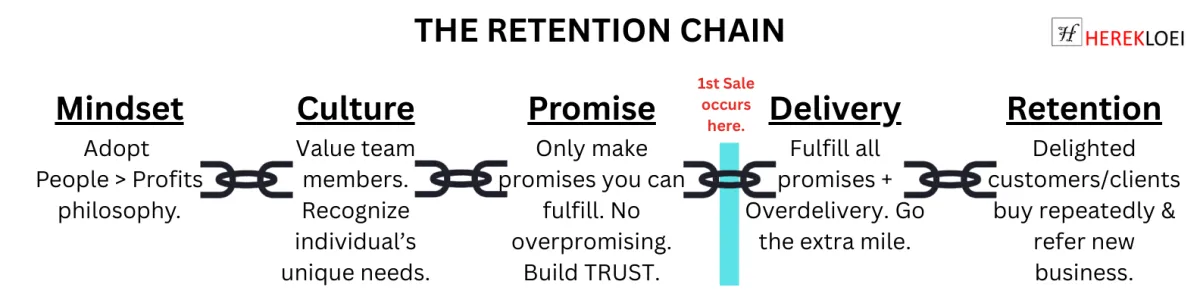
When businesses want a macro view of how to design retention intentionally in the business...
They'll refer to the Retention Chain.
So they'll know that Retention is an outcome.
And they can focus on the right processes that lead to the outcome.
Focusing on the wrong process = Retention failure.
The Micro View For Client Acquisition And Hiring Team Members
If we zoom into a layer deeper... You'll see the micro view.
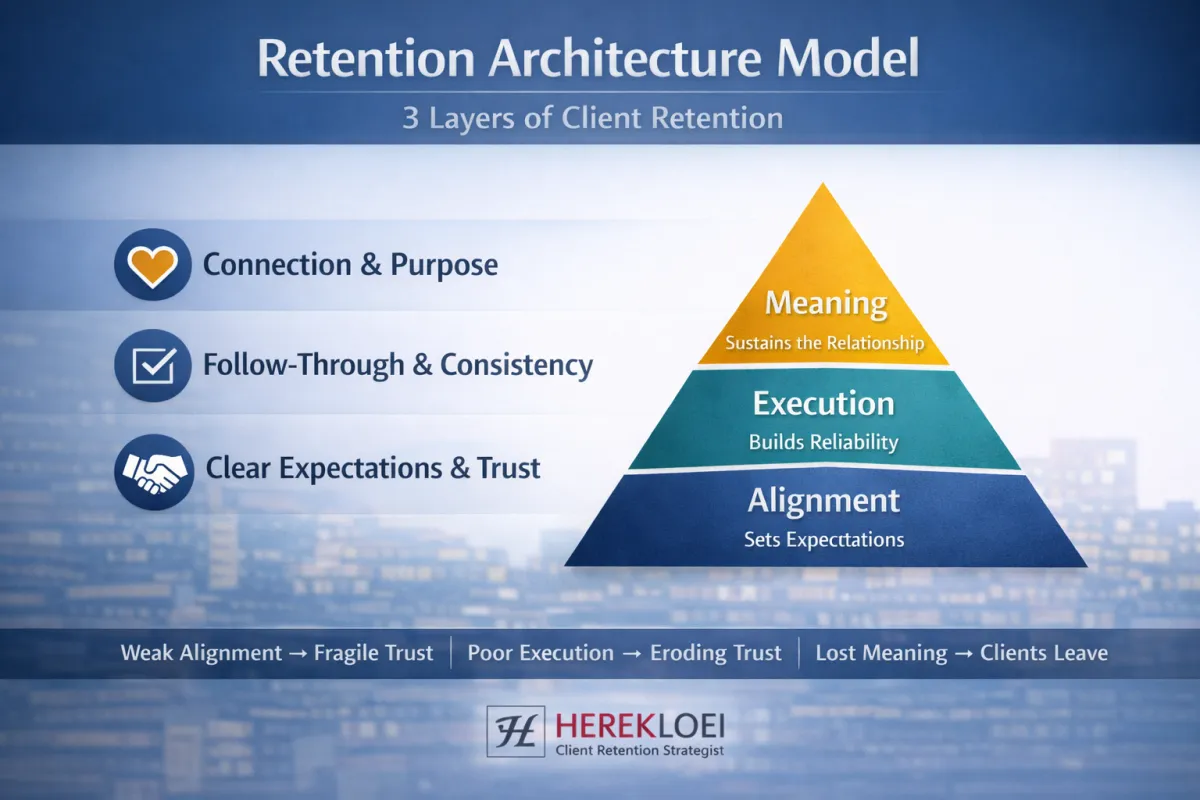
The Retention Architecture Model is the framework that shows the hierarchy.
It explains how to build trust with Alignment...
How to sustain trust at the Execution level.
Then finally... How to install Meaning and establish a long-term relationship.
Can you see how it ties back to The Retention Formula mentioned at the beginning?
The Retention Architecture Model applies to acquiring and retaining clients.
It's also applicable to acquiring and retaining team members.
Because every human relationship needs to start with alignment to last.
When a relationship starts without alignment... Retention is bound to fail.
There will be a fallout. It's just a matter of when.
When I talk about alignment...
I mean:
Alignment of values.
Alignment of working styles.
Alignment of direction
A misaligned relationship leads to a lack of rapport.
Lack of emotional connection.
Lack of trust.
Lacking these also means lack of emotional safety.
Clients don't buy when they don't feel safe.
Team members can't maximize their performance when they don't feel safe.
There are no winners in a misaligned relationship.
Where Do FOCA And The Trust Pie Fit?
Now, we're down to the last 2 frameworks: FOCA and the Trust Pie.
FOCA sits in the "Execution" layer of the Retention Architecture Model.
It shows people the 4 things they can do to sustain trust:
1) Fulfillment of ALL promises.
2) Overdelivery to represent commitment and care.
3) Consistency and Congruence of words and actions.
4) Authenticity in showing up. No pretense. No performance.
These 4 actions fixes the trust leaks.
So naturally, FOCA is an extension of the Retention Architecture Model.
Since FOCA shows actionable moves to sustain trust...
What does trust comprise of?
Trust is not just 1 thing.
There are 4 ingredients to the Trust Pie.
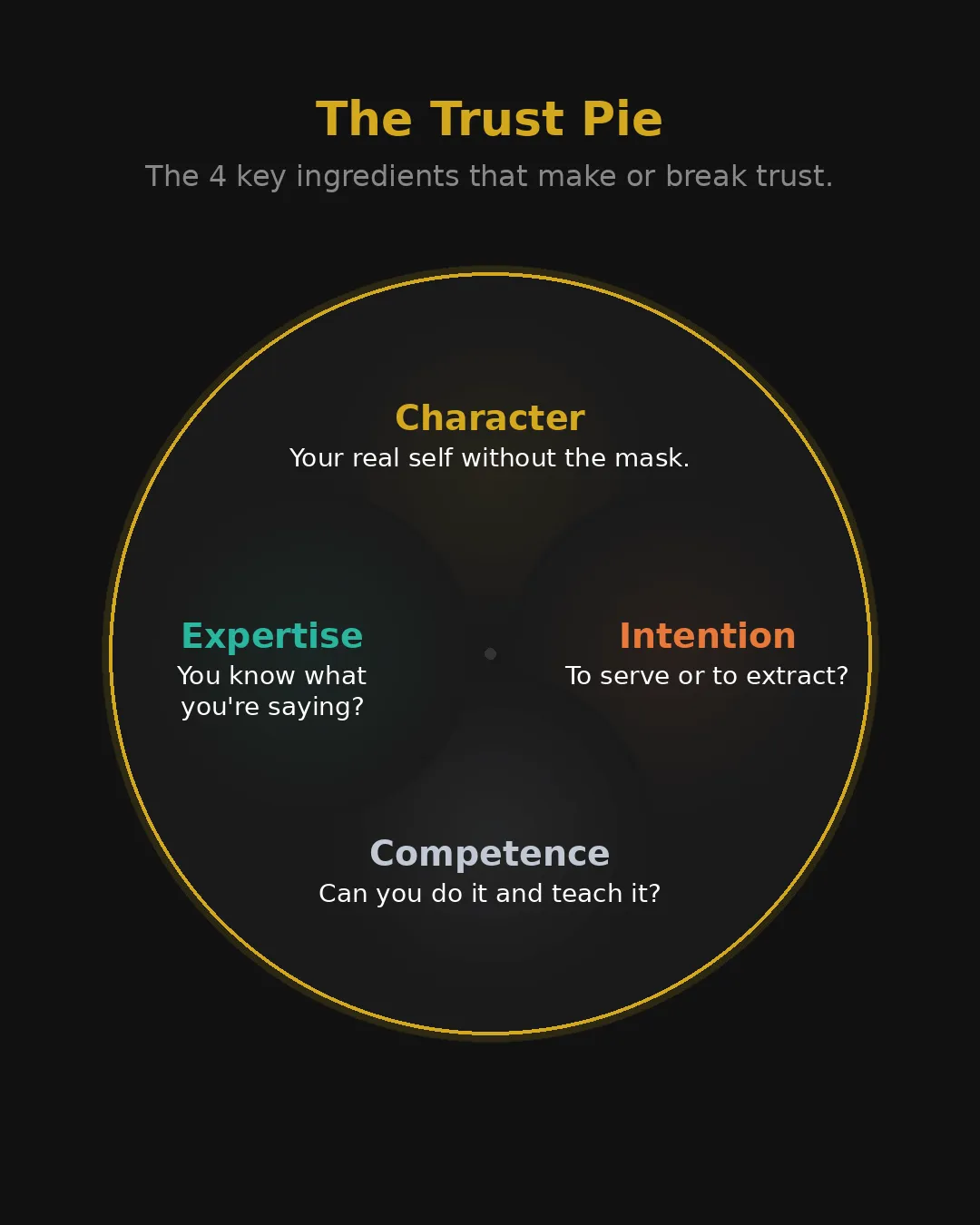
The 4 ingredients are:
- Trust in Expertise.
- Trust in Competence.
- Trust in Character.
- Trust in Intention.
Not all trust types are equal.
But all 4 types of trust are important on its own.
Voluntary Retention can be achieved more easily when all 4 types of trust are present.
Voluntary Retention is the only type of retention that creates loyal clients and active referrals.
People stay willingly because they want to.
Because they're happy.
Because they had a great experience.
Because Trust and Meaning are present.
No gimmicks, promotions and loyalty programs are needed to persuade people to stay.
Forced Retention and Utility Retention will not be discussed here.
Because Forced and Utility Retention can still take place with eroded trust and loss of meaning.
So even if clients are staying... They may be already actively looking for an out.
Tying All The Frameworks Together
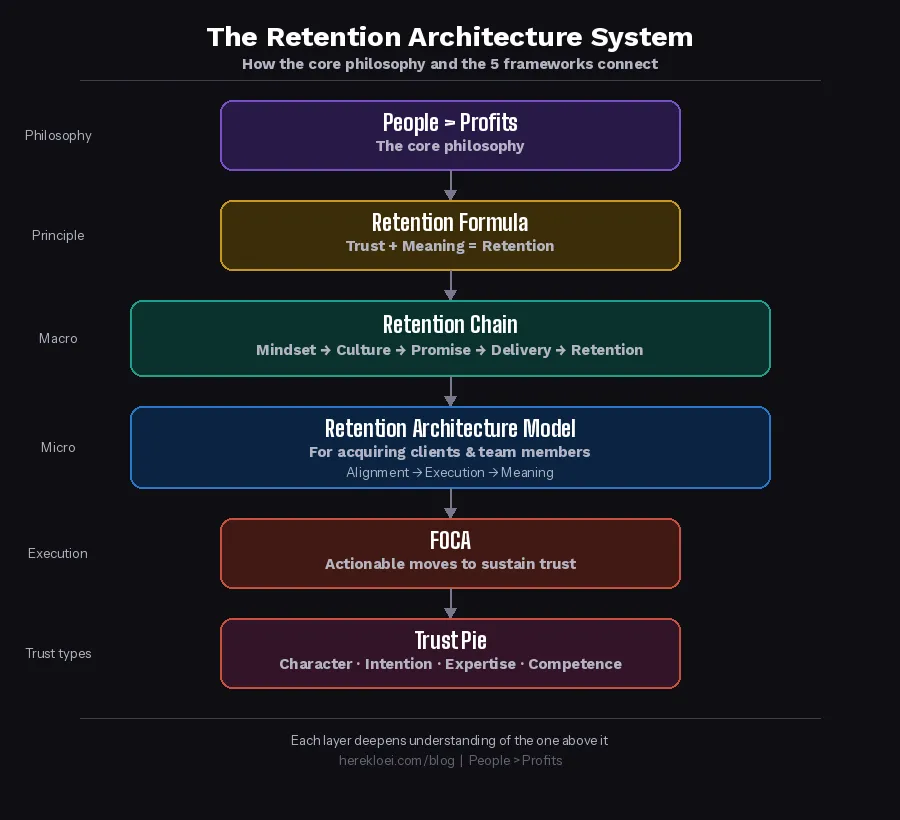
This diagram summarizes everything I've said above in 5 seconds.
You can see the entire Retention Architecture SYSTEM.
In case you're confused... The Retention Architecture MODEL is a part of the SYSTEM.
Each layer builds on the previous one.
There's a clear hierarchy.
One important point to note:
Of course you can just take 1 layer of the whole system and start applying it today.
But without the previous layers that set the foundation...
It's likely there will be trust leaks somewhere down the line.
And that will mean a waste of time and resources on your end.
So if you really want to retain more clients and build a durable business...
Start with the philosophy first:
People > Profits.
Always.
Because humans like to be served, not sold.
No one likes to stay with a business that treats them as cash cows.
No one trusts a business that consistently extracts money from them.
- Herek
P.S. If you'd like to explore more of my Client Retention content...
Feel free to follow me on the following platforms:
- LinkedIn.
- YouTube.
If you'd like to have a peek at my personal life...
I post more personal stuff on:
P.P.S. In case you missed it... Read the Client Retention Top 10 FAQs HERE. Then you'll understand our philosophy behind everything we do.
I look forward to sharing more with you in the next post.
If you enjoyed reading this post... Feel free to check out the other posts!
Table of Contents
#8: What Is The Retention Architecture Model: The 3 Layers Explained
#9: The Hidden Costs Of Ignoring Retention Principles (No One Talks About This)
#10: Why Clients Still Leave Despite Enjoying Great Service?
#11: Why Have Traditional Marketing Tactics Lost Effectiveness?
#13: Why Businesses Lose Clients: The Hidden Role Of Trust Leaks
#16: Where Does Client Trust Break Down? The Trust Leak Stages Explained
#17: Why Tactical Optimization Can't Fix Weak Business Foundations
#18: What Should Consultants Do When Clients Insist On Their Ideas?
#21: Why Do Clients Request A Refund? (It's Not What You Think)
#22: Case Study 1 - How Retention Principles Saved A Marriage...
#25: Read This If You Use AI In Business (It's Killing Client Retention... And More)
#29: How To Increase Client Lifetime Value Using Retention Principles
#30: Why Most Client Retention Tactics Don't Work (And What Actually Does)
#31: Why Business Partnerships Fail (And How Retention Principles Fix It)
#32: How To Increase Client Retention (Without Contracts & Loyalty Programs)
#33: Planned Obsolescence: How Software Updates Quietly Profit From Your Trust
#34: The Retention Architecture System: How All The Frameworks Come Together
Disclaimers: The content in this blog contains the personal opinions of Herek Loei. These are based on real-life events experienced by Herek, that shaped his worldview. Herek's sharing of experience does not mean you must agree with him. Herek does not impose his views on anyone. You're free to choose to stay on this site if what he shares resonates with you. If it doesn't, you've the choice to leave this site too.
Some events described in the blog may have happened many years ago. Herek can only narrate based on his memory. Herek can't cover the minute details. Hence, we make no guarantees that this page is 100% error-free.
We also make no representations that you'll make money from following the information provided on this page. Results will vary depending on how you implement what you learned. You agree NOT to hold us liable for your own decisions, actions, and lack of results.
Results variation depends on many factors, including but not limited to your background, knowledge, experience, and work ethic. All business entails risk as well as massive and consistent effort and action. If you're not willing to accept that, please do not consume our materials or attend our programs.
The information provided here is for educational purposes only. It does not represent any professional medical, legal, or financial advice. Consumer discretion is advised.
Copyright 2026. All Rights Reserved.
Revenue Growth Pte. Ltd. | Herek Loei