Herek's Blog
The Art & Science of
Client Retention
The place where I share my deep thoughts, observations, experiences, and frameworks
#28: What is the trust Pie? 4 types of trust explained
The Retention Formula states Trust + Meaning = Retention.
But do you know that not all trust is equal?
There are 4 types of trust.
I'll explain each type in this blog post.
I'll also show you how each type of trust is earned or broken.
By the time you finish reading this post...
You'll have clarity about which specific kinds of trust you're strong at.
And of course, which kind of trust are you lacking?
People usually say, "You need to build trust with the audience, then they will buy."
They say you need 7-11-4 content strategy to build trust.
7 hours of content.
11 touch points.
4 different platforms.
So what type of trust are they really referring to?
I reflected and deconstructed my personal experiences.
I deconstructed what happened during the interactions with my clients.
I examined how my clients were perceived by their audience.
And I observed how other businesses communicated with me through their products and services.
This leads me to design "The Trust Pie"
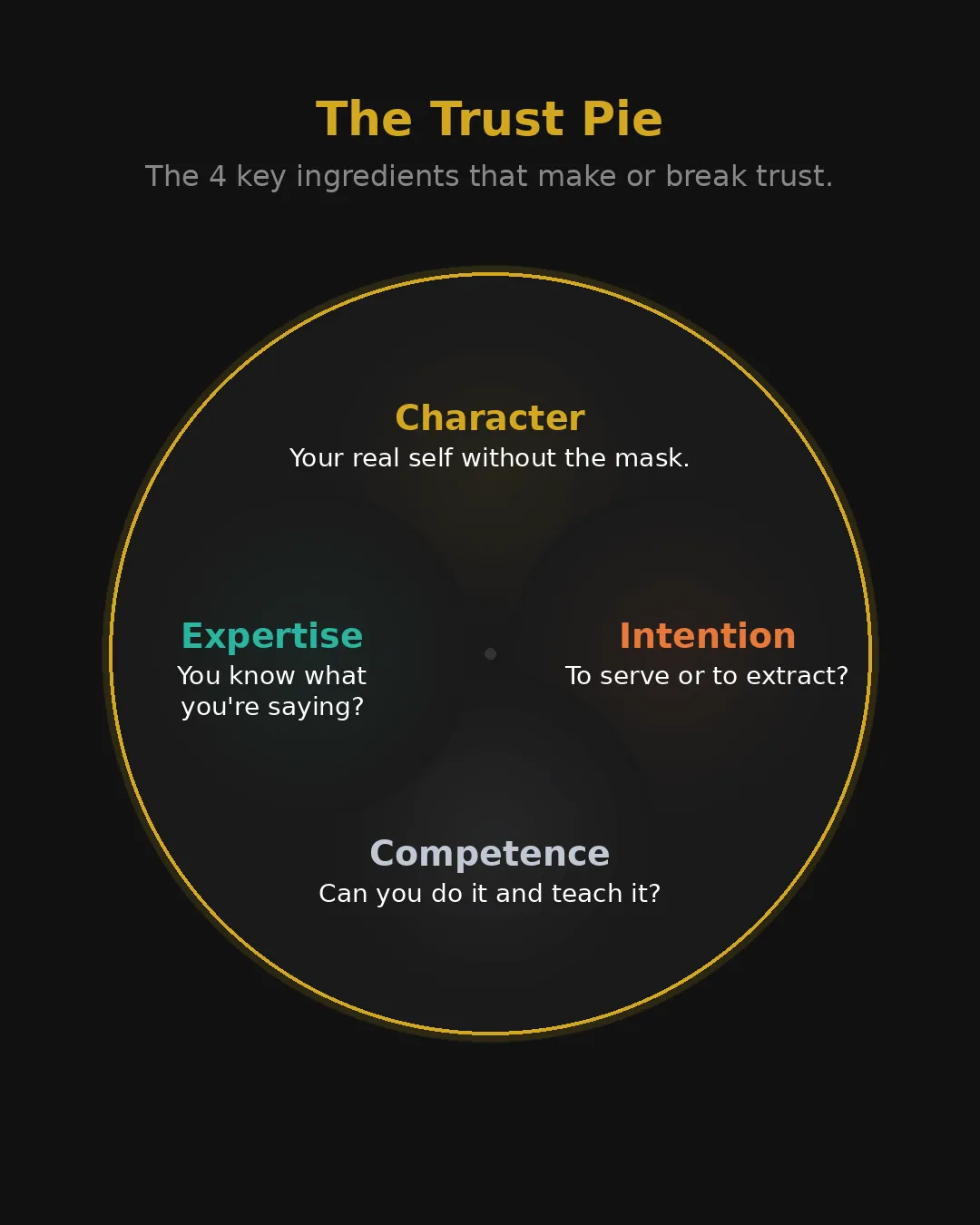
What is The Trust Pie?
The Trust Pie has 4 ingredients.
I call them ingredients because all are important.
Just like making a dish...
The food tastes different or weird if we omit 1 or more ingredients.
Each ingredient has its place and importance in this Trust Pie.
Certain people will place greater weight on a specific ingredient.
Some people value expertise and competence more than anything else.
Some people may value character and intention over others.
There's no fixed hierarchy.
Each of these ingredients can make or break trust.
They are also interconnected with each other.
The loss of 1 often leads to another's erosion.
Absence of any one of them can lead to retention failure.
Remember?
So the "Trust" in that Retention Formula can be further expanded to show each of the 4 ingredients.
The 4 ingredients are:
Trust in expertise.
Trust in competence.
Trust in character.
Trust in intention.
We'll now dive into each one and see what it's about.
Please note that the examples we'll discuss below are non-exhaustive.
Trust in expertise
When you're buying any product or service...
It's normal to check for relevancy first:
Do I want this?
Do I need this?
If something isn't relevant, we don't usually pay attention to it.
So there's no trust to talk about. It's not needed.
But if it's relevant, then we want to make sure they have the required expertise.
Here's how this works.
If you're looking to improve in your basketball skills... You won't look for a football coach.
If you're looking to write a book... You'll look for a book coach or authors who have the expertise.
If you're looking to learn funnel building... You'll want to learn from a person who is experienced and understands the nuances.
Otherwise, it doesn't make sense.
How do you trust someone's expertise then?
You want to make sure they know what they're talking about.
There are signals to look for.
You can look at what they say or write in their content.
Do they make sense?
Any parts that defy logic?
Are they superficial or in-depth?
You can look at social proof.
Do they already have a track record?
People tend to trust those with long track records.
You can also look at credentials, media features, and qualifications.
The above are generally the signals people look for to decide...
Does this person know what they're talking about?
Trust in competence
If you have expertise and people already trust your expertise...
It's still not enough to convince people to buy.
Especially if you're in the coaching and consulting niche.
Let's say you're an expert in any field.
You're an author, speaker, coach, or consultant...
This is critical.
Because people need to make sure they can apply what you teach.
Can you apply and do what you teach?
They not only need to see proof that you have the knowledge...
They also want to see what you share really works.
They need to see that you can communicate effectively to transfer your knowledge to them.
This is why people look for competence.
Some coaches or mentors appear to be very good at presenting and speaking.
But they may just know a topic superficially.
They can go wide, but have no depth.
Some of them look knowledgeable. They look like they have expertise.
But they may be regurgitating someone else's content.
Or their content is written by AI.
They have no real expertise.
When that's the case, they won't have the competence to show.
Lack of expertise translates to lack of competence.
This serves as an additional filter for people to check if the perceived expertise is legit.
When trust in expertise and trust in competence are established...
People have peace of mind, knowing this is a legitimate choice.
Trust in intention
If you think trust in expertise and trust in competence are enough to make sales...
It's true for some buyers.
Especially if it's a low-risk purchase.
Maybe there's a guarantee in place, and it feels safe.
Maybe it's a low-ticket offer. People don't mind taking a chance.
But when it comes to higher ticket offers...
People want to know one thing: Are you safe to buy from?
You know why door-to-door salesmen are finding it hard to close sales?
Because people treat them like annoying pests.
They knock on doors uninvited and interrupt people's time at home.
They usually push products and whatever agendas they have...
Without asking if the things they sell are relevant to who they're talking to.
When people hear a stranger pitching them...
They automatically get defensive.
Their nervous system tells them "Danger. It's not safe. This person is trying to take your money."
The same applies to telemarketers who cold-call.
They interrupt people's day with their phone calls and try to sell.
People immediately know their agenda is to sell, not to serve.
The common reason people don't buy and shut them off is simple.
People don't trust their intentions.
Ever heard of the term "commission's breath"?
When people know you're self-serving...
They don't trust you.
No trust = No sale = No retention.
Even when a coach or consultant has gained trust in expertise and competence...
People can be reluctant to buy if they sense the intention is self-serving.
People trust those who have their best interests at heart.
People trust those who prioritise service over extraction.
When people sense you're genuinely helping them...
They lower their defenses.
They open up emotionally because they feel safe.
Here are some signals that can make or break trust in intention:
The words used in communication are extractive language.
For example, "Milk them dry", "Tripwire", "mind-control your customers", etc.
Being flashy in wealth and luxury.
The goal is to let people want what they have.
Then people will be interested to learn their "money-making secrets".
They often "sell the dream" and focus on client acquisition, not retention.
Another obvious one is their frequency of following up.
Some people only send emails to follow up when they want to sell stuff.
It's easy to understand they're not interested in communicating with you.
They only think of you when they want to make money from you.
When a person is committed to serving, they'll be interested in helping you solve your problems.
They'll find out what problems you're facing, what you want to achieve, and diagnose the root cause.
They'll make suggestions that benefit you.
They'll be open about their own limitations.
They'll willingly refer you to another person if they recognise you're not the right client fit...
Even if there aren't monetary rewards.
Trust in character
This is a huge one.
When people trust your character, it's easy to make sales.
That's how strong personal brands monetize easily.
But it's difficult to vet for this before the sale.
Unless you have various opportunities to interact with the person to detect inconsistencies.
Trust is usually lost after the sale because of this.
Especially when there's an incongruence between the public image and the true self in private.
For example...
Before I hired my first coach, he was very warm and patient.
He answered all my questions and seemed to be caring.
After I hired him and made my payment, the attitude changed.
The pre-sale warmth turned into post-sale coldness.
My questions were brushed away condescendingly.
So trust in character was eroded.
I know he's just performing a persona publicly.
Another example.
A company CEO portrayed himself as a religious and caring family man.
He talked about how he worked hard for his family.
Then, news of his affair with a co-worker spread like wildfire.
Social media comments left under those news articles were brutal.
The public outburst is because of the incongruence.
Public persona doesn't match private behaviors.
People felt they were taken for a ride.
Trust in character was destroyed for the CEO.
The company's reputation is also affected.
Because the CEO is the face of the company.
Naturally, trust in the company is lost too.
This not only impacts the sales... It also impacts the retention.
Many staff have since left the company.
How all ingredients interact in the trust pie
When a person makes a purchase...
Or when they're deciding whether to continue staying with a business...
Their minds go through these 4 ingredients.
So they can make the best possible decision without regret.
Different people prioritise different ingredients.
Some look for expertise and competency first.
Some look for intention and character first.
When trust is lost, it can mean loss of one or more ingredients.
Loss of one ingredient can lead to the loss of the other ingredient.
Example 1:
Loss of trust in expertise naturally extends to loss of trust in competence.
You can't expect someone to be competent in something they have no expertise in.
Example 2:
Loss of trust in character can lead to loss of trust in intention.
Because when people doubt your character...
They're doubting your values and integrity.
They may also doubt your intentions are of genuine service.
Now you understand the 4 ingredients in the Trust Pie.
Which ingredient needs more work to establish trust with the people you serve?
Which ingredient is already strong enough in your business?
You'll realize when you adopt the People > Profits philosophy in your business...
All 4 ingredients of the Trust Pie get easily established.
Because you'll ensure you've true expertise before starting your marketing.
You'll make sure you have competence in what you teach to benefit the people you serve.
You'll prioritise service over extraction and become the trusted advisor. Your genuine intentions can be felt.
You'll act with integrity and know when to walk away when a decision hurts the people you serve. That's a strong signal of character.
These will be your unfair advantage in the long term.
Trust and reputation compound over time.
Short-term extraction erodes trust.
If you want a business that clients willingly stay with and never want to leave...
Prioritise People > Profits.
Always.
- Herek
P.S. If you'd like to explore more of my Client Retention content...
Feel free to follow me on the following platforms:
- LinkedIn.
- YouTube.
If you'd like to have a peek at my personal life...
I post more personal stuff on:
P.P.S. In case you missed it... Read the Client Retention Top 10 FAQs HERE. Then you'll understand our philosophy behind everything we do.
I look forward to sharing more with you in the next post.
If you enjoyed reading this post... Feel free to check out the other posts!
Table of Contents
#8: What Is The Retention Architecture Model: The 3 Layers Explained
#9: The Hidden Costs Of Ignoring Retention Principles (No One Talks About This)
#10: Why Clients Still Leave Despite Enjoying Great Service?
#11: Why Have Traditional Marketing Tactics Lost Effectiveness?
#13: Why Businesses Lose Clients: The Hidden Role Of Trust Leaks
#16: Where Does Client Trust Break Down? The Trust Leak Stages Explained
#17: Why Tactical Optimization Can't Fix Weak Business Foundations
#18: What Should Consultants Do When Clients Insist On Their Ideas?
#21: Why Do Clients Request A Refund? (It's Not What You Think)
#22: Case Study 1 - How Retention Principles Saved A Marriage...
#25: Read This If You Use AI In Business (It's Killing Client Retention... And More)
#29: How To Increase Client Lifetime Value Using Retention Principles
#30: Why Most Client Retention Tactics Don't Work (And What Actually Does)
#31: Why Business Partnerships Fail (And How Retention Principles Fix It)
#32: How To Increase Client Retention (Without Contracts & Loyalty Programs)
#33: Planned Obsolescence: How Software Updates Quietly Profit From Your Trust
#34: The Retention Architecture System: How All The Frameworks Come Together
Disclaimers: The content in this blog contains the personal opinions of Herek Loei. These are based on real-life events experienced by Herek, that shaped his worldview. Herek's sharing of experience does not mean you must agree with him. Herek does not impose his views on anyone. You're free to choose to stay on this site if what he shares resonates with you. If it doesn't, you've the choice to leave this site too.
Some events described in the blog may have happened many years ago. Herek can only narrate based on his memory. Herek can't cover the minute details. Hence, we make no guarantees that this page is 100% error-free.
We also make no representations that you'll make money from following the information provided on this page. Results will vary depending on how you implement what you learned. You agree NOT to hold us liable for your own decisions, actions, and lack of results.
Results variation depends on many factors, including but not limited to your background, knowledge, experience, and work ethic. All business entails risk as well as massive and consistent effort and action. If you're not willing to accept that, please do not consume our materials or attend our programs.
The information provided here is for educational purposes only. It does not represent any professional medical, legal, or financial advice. Consumer discretion is advised.
Copyright 2026. All Rights Reserved.
Revenue Growth Pte. Ltd. | Herek Loei