Herek's Blog
The Art & Science of
Client Retention
The place where I share my deep thoughts, observations, experiences, and frameworks
#24: How to improve client retention?
Many businesses lose clients unnecessarily.
But they've no idea what went wrong.
Instead of thinking about improving retention and reducing churn...
They double down on marketing to get more clients.
They try to optimize their funnel to increase conversions.
They've got the fundamentals wrong.
Marketing and sales help them acquire new clients.
But that's only part of the equation.
Marketing can't save a business with a weak foundation.
All businesses have 4 pillars:
1) Marketing
2) Sales
3) Fulfillment
4) Retention.
When they only focus on marketing and sales...
The fulfillment and retention fall short.
Little do they know...
The better the fulfillment, the easier the retention.
And retention compounds acquisition...
Not the other way round.
A business that focuses on acquisition without retention = A leaky business losing clients unnecessarily.
A business that focuses on acquisition WITH retention = A sustainable and durable business.
Now, let's explore...
How do we improve client retention?
After that, we'll dive deeper into how retention compounds acquisition.
How to improve client retention?
The retention formula is:
Trust + Meaning = Retention.
When either "Trust" or "Meaning" is missing...
Retention fails.
Increasing both "Trust" and "Meaning" will lead to increased "Retention."
If you want to understand how the formula works...
Read Blog Post #3 here.
Earlier, I mentioned, "The better the fulfillment, the easier the retention is."
Because the way you fulfill tells a lot.
Clients can feel your passion, your commitment, and your care.
For most businesses, the majority of the "Trust" is lost here.
But it starts much earlier at the beginning of the relationship.
Trust is a feeling.
It isn't tangible.
But what you do will affect how clients feel about you and your business.
The best way to improve client retention is:
Design retention into the business with intention.
Retention should be considered throughout the entire client journey.
People > Profits should be the guiding philosophy throughout.
Alignment
The first step is to ensure Alignment.
Your business should be aligned in values, beliefs, offers, messaging, and the clients you attract.
The expectations you create should be aligned with what you can actually deliver.
The promises you make should be aligned with the results you know you can create.
These steps build trust before the sale.
It reduces the chances of clients experiencing a nasty surprise after purchase.
Without alignment... Retention failure is already seeded at the start.
It's difficult to drive retention when clients experience an expectation gap.
When their disappointment accumulates...
They leave quietly.
Or they escalate into a complaint.
Some may vent on social media and create negative reviews.
Some may even choose the legal route and sue the business.
Execution
The second step is Execution.
At this stage, it's all about how you execute your fulfillment.
Does your behavior sustain the trust that's been built earlier?
Many businesses lose trust at this step.
Acquisition-focused businesses are prone to commit this mistake.
They make big claims to attract clients.
But when they couldn't fulfill...
Clients get angry and disappointed.
Trust erodes.
The clients who left may leave negative reviews.
They become the reason new prospects don't buy.
How do you improve retention at this stage, then?
It's built upon the foundation of: Alignment.
When there's misalignment... Many trust leaks will surface at this stage.
With alignment...
Trust leaks are greatly reduced.
Promises made earlier will be fulfilled.
Trust increases when you over-deliver instead of doing the bare minimum.
Over-delivery helps you stand out.
It's how clients know your commitment and conviction.
It's also how they know you care for them...
When you voluntarily give them more than what they paid for.
When you fulfill promises consistently...
Show up consistently each time...
Help your clients solve problems consistently...
Trust grows.
When you're congruent in your words and actions...
You're authentic...
You're genuinely putting their best interests first...
Clients know you're trustworthy over time.
They see you as their trusted advisor... A partner.
They no longer see you as a service provider or marketer.
They know you have their back.
Meaning
The third step is Meaning creation.
From Blog Post #3, you already know "Trust" itself isn't sufficient to keep clients.
People want to have a sense of belonging.
They want to be part of a movement.
If you can give your clients that...
They naturally want to stay with your business.
The following questions will help you diagnose whether you've done a good job in creating meaning...
a) Is what you offer still relevant to where your client is? Are they still experiencing growth from the value you provide?
b) Do your clients feel that you care for them?
c) Do you have a community of like-minded people for your clients to network and gain support?
d) Do your clients feel a sense of belonging in the community you created?
e) Do your clients feel a sense of contribution in the community?
f) Have you communicated clearly what you stand for?
g) Have you communicated what you stand against and why?
All these questions are based on principles of human behavior.
Every human likes to feel seen, heard, understood, valued, and respected.
Every human has this 6 core human needs: Certainty, uncertainty, growth, contribution, significance, and love.
Humans make decisions that feel safe.
When humans have a sense of purpose, they have emotional investment to stay.
People leave transactions easily. They don't leave meaningful relationships easily.
Without meaning... The clients who stay aren't staying because of loyalty.
They may be staying because of convenience.
That's utility retention.
It's also delayed churn.
It's only a matter of time, they'll leave...
As soon as they find a better alternative to what's offered now.
You can read more about The 3 Types of Retention here.
If you've read my earlier posts...
You'd also realize that Alignment, Execution, and Meaning are the 3 layers covered in Blog Post #8: What is the Retention Architecture Model.
Read that post to gain a deeper understanding.
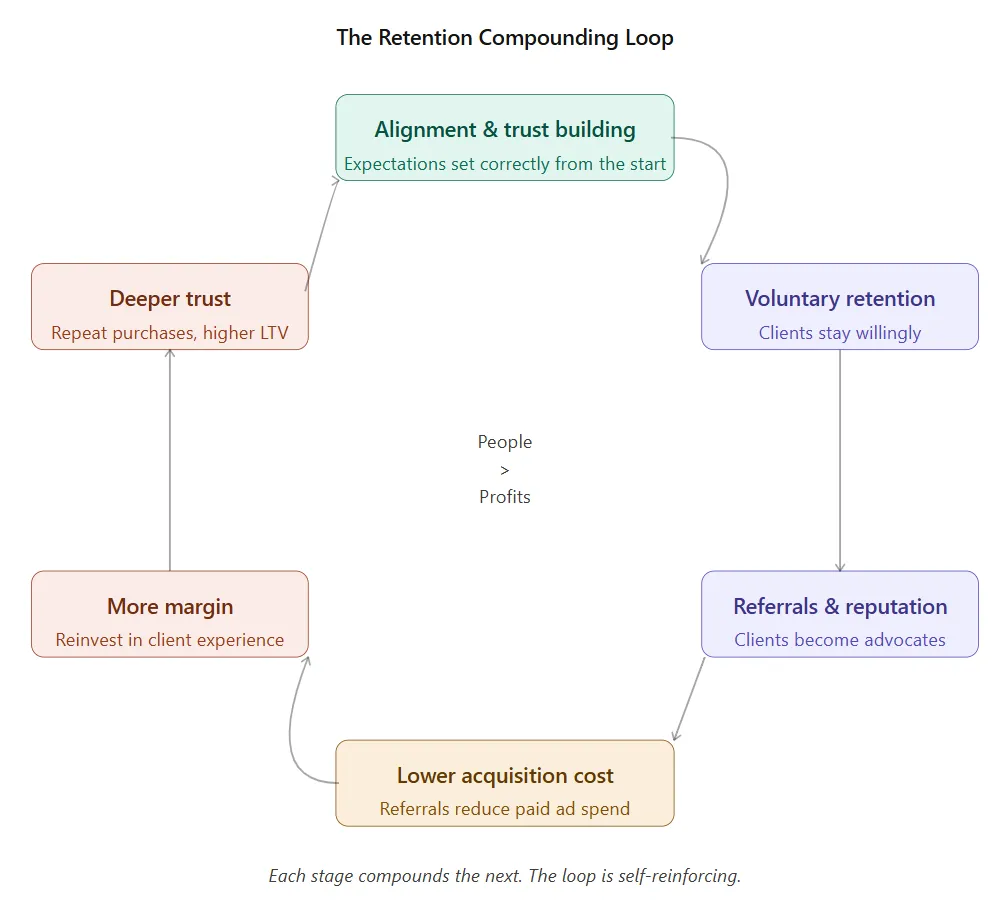
Putting it all together: The Retention Compounding Loop
If you want to know how to improve client retention...
We've already covered the necessary grounds to answer that question.
Following the Retention Architecture Model will improve client retention.
Because it minimizes the number of trust leaks at each stage of the client journey.
You can go to Blog Post #16 to understand where trust leaks occur exactly.
But here's what many businesses miss out.
The most powerful thing about retention is... It compounds acquisition.
I mentioned it at the beginning of this post.
Now, I'll elaborate.
The illustration above shows clearly:
The central philosophy behind client retention is "People > Profits."
If you have your clients' best interests at heart for every decision...
Their trust in you goes deeper.
On the contrary, when businesses focus on Profits > People...
Trust erodes.
So retention fails.
They don't trust those who are only looking for opportunities to extract more money.
Here's the magic:
When "Alignment and trust building" is done well...
It leads to "Voluntary retention."
People stay willingly because they want to.
Not because they have to.
Not because they're forced to.
These clients are in a positive state after having pleasant experiences.
Clients are more likely to leave positive reviews after a great experience.
They're more likely to say good things about your business.
Positive word-of-mouth referrals start spreading organically.
Your good reputation compounds.
Prospects come to you, already pre-framed.
They've decided to work with you without you needing to sell.
This leads to lower acquisition costs.
When trust is high in your business...
The market doesn't need you to persuade or convince them to buy.
Prospects convert into clients easily.
This means you don't need to spend as many marketing dollars now.
Your profit margins can become higher.
It allows you to reinvest and improve your product or service.
You can create an even better and more memorable experience for clients.
When clients trust you more...
And they have a close working relationship with you...
They're more likely to make repeated purchases from you.
They're more likely to spend more on each transaction.
Their lifetime value continues to increase.
Lifetime value has no ceiling.
It's only limited by the amount of value you can continue to provide.
As long as you're able to continue serving your clients at a deeper level...
They'll willingly pay.
During their new purchase...
It all goes back to how you set expectations and fulfill your promises.
Trust can still break when you drop the ball this time.
Past retention isn't a predictor of future retention.
But when you focus on retention... Acquisition also takes care of itself.
Retention is a long-term commitment.
It requires commitment, consistency, and dedication to serve your clients well.
The compound effects of retention aren't immediate.
That's why retention isn't a sexy topic to sell.
That's why many gurus prefer to focus on teaching marketing, funnels, ads, and copywriting.
Because the results of tweaking any of those can be seen in the numbers changing on the dashboard.
It's easier to sell when results are tangible and almost immediate.
Everybody likes seeing fast results.
Most people want quick money.
That's why there's no category king for client retention at this point.
And that is why I do what I do to fill the gap in the market.
Even though it's difficult to educate the market.
Even though it's going to take a lot of effort.
But just because it's difficult doesn't mean I shouldn't do it.
Someone has to do the hard but necessary work.
And that someone is me.
I do it because it's difficult.
People > Profits.
Always.
- Herek
P.S. If you'd like to explore more of my Client Retention content...
Feel free to follow me on the following platforms:
- LinkedIn.
- YouTube.
If you'd like to have a peek at my personal life...
I post more personal stuff on:
P.P.S. In case you missed it... Read the Client Retention Top 10 FAQs HERE. Then you'll understand our philosophy behind everything we do.
I look forward to sharing more with you in the next post.
If you enjoyed reading this post... Feel free to check out the other posts!
Table of Contents
#8: What Is The Retention Architecture Model: The 3 Layers Explained
#9: The Hidden Costs Of Ignoring Retention Principles (No One Talks About This)
#10: Why Clients Still Leave Despite Enjoying Great Service?
#11: Why Have Traditional Marketing Tactics Lost Effectiveness?
#13: Why Businesses Lose Clients: The Hidden Role Of Trust Leaks
#16: Where Does Client Trust Break Down? The Trust Leak Stages Explained
#17: Why Tactical Optimization Can't Fix Weak Business Foundations
#18: What Should Consultants Do When Clients Insist On Their Ideas?
#21: Why Do Clients Request A Refund? (It's Not What You Think)
#22: Case Study 1 - How Retention Principles Saved A Marriage...
#25: Read This If You Use AI In Business (It's Killing Client Retention... And More)
#29: How To Increase Client Lifetime Value Using Retention Principles
#30: Why Most Client Retention Tactics Don't Work (And What Actually Does)
#31: Why Business Partnerships Fail (And How Retention Principles Fix It)
#32: How To Increase Client Retention (Without Contracts & Loyalty Programs)
#33: Planned Obsolescence: How Software Updates Quietly Profit From Your Trust
#34: The Retention Architecture System: How All The Frameworks Come Together
Disclaimers: The content in this blog contains the personal opinions of Herek Loei. These are based on real-life events experienced by Herek, that shaped his worldview. Herek's sharing of experience does not mean you must agree with him. Herek does not impose his views on anyone. You're free to choose to stay on this site if what he shares resonates with you. If it doesn't, you've the choice to leave this site too.
Some events described in the blog may have happened many years ago. Herek can only narrate based on his memory. Herek can't cover the minute details. Hence, we make no guarantees that this page is 100% error-free.
We also make no representations that you'll make money from following the information provided on this page. Results will vary depending on how you implement what you learned. You agree NOT to hold us liable for your own decisions, actions, and lack of results.
Results variation depends on many factors, including but not limited to your background, knowledge, experience, and work ethic. All business entails risk as well as massive and consistent effort and action. If you're not willing to accept that, please do not consume our materials or attend our programs.
The information provided here is for educational purposes only. It does not represent any professional medical, legal, or financial advice. Consumer discretion is advised.
Copyright 2026. All Rights Reserved.
Revenue Growth Pte. Ltd. | Herek Loei